
What Is Blockchain? Meaning, How It Works and Why It Matters
A blockchain is a shared digital record of transactions that is copied across thousands of computers and can’t easily be changed. It is the technology behind bitcoin, stablecoins and most of crypto. This guide explains what a blockchain is, how it works, key terms such as nodes, validators, layer 2 and hard forks, and how to use a blockchain explorer to check a transfer yourself.
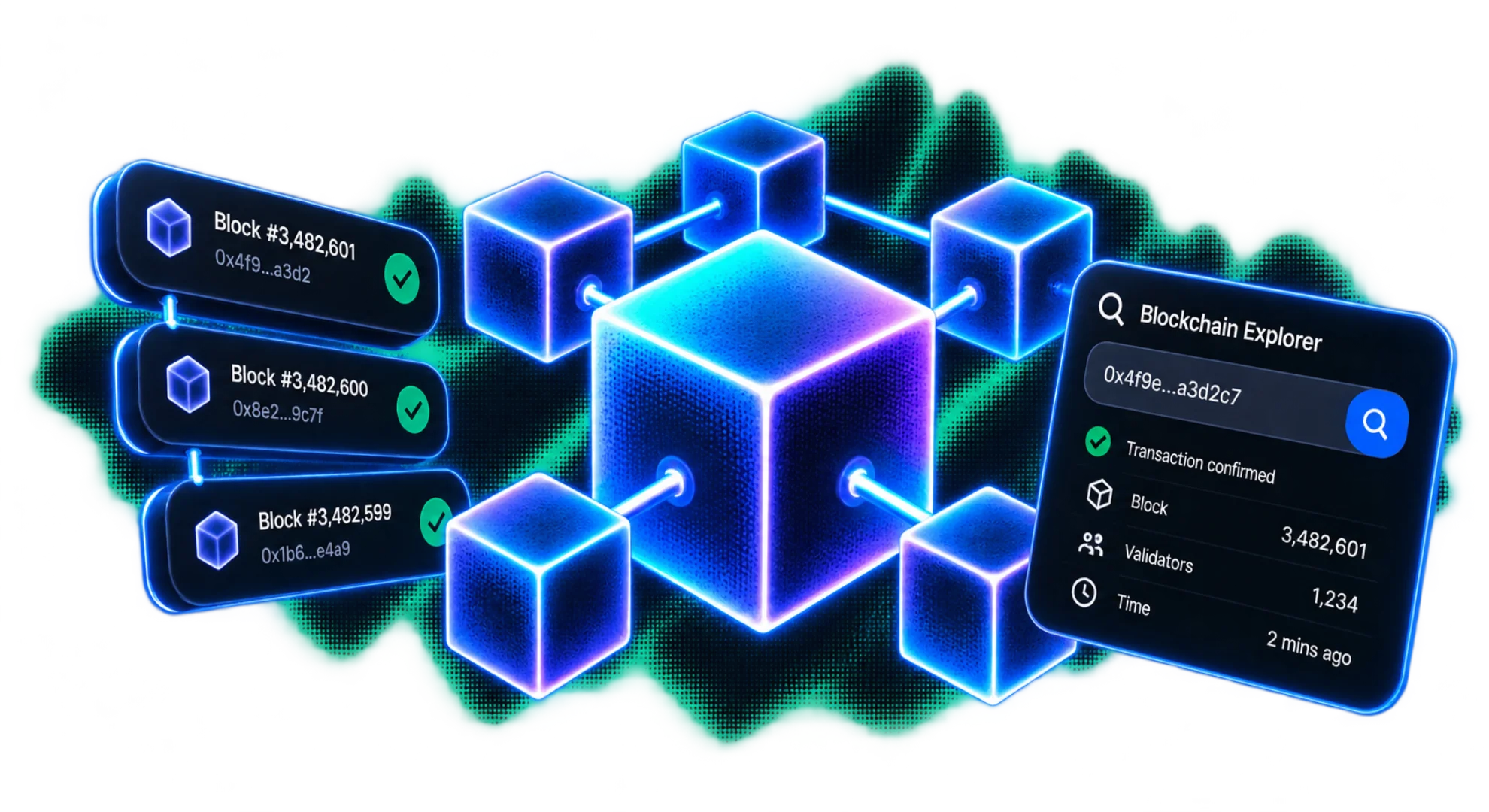
Blockchain Meaning in Short
The essentials in five points:
- A blockchain is a public record of transactions, grouped into blocks and linked in order.
- Thousands of computers called nodes keep copies of it, so no single party controls it.
- New transactions are checked and added by miners or validators.
- Once a transaction is confirmed, it is extremely hard to change or reverse.
- Anyone can look up transactions on public blockchains using a blockchain explorer.
What Is Blockchain?
A blockchain is a type of database, often called a distributed ledger. Instead of one company keeping the record on its own servers, the same record is kept by many independent computers that agree on every update. This makes it possible to transfer value between strangers without a bank in the middle.
Blockchain vs a Traditional Database
A bank’s database is controlled by the bank: it can edit, reverse or freeze records. A public blockchain is shared: every node holds a copy, changes must follow the network’s rules, and past records can’t be quietly edited. The trade-off is speed and flexibility. Blockchains are usually slower and costlier per transaction than a central database.
| Traditional database | Public blockchain | |
|---|---|---|
| Who controls it | One organisation | A network of independent nodes |
| Can records be edited | Yes, by the owner | Practically no |
| Who can view it | Usually only the owner | Anyone |
| Mistakes reversible | Often | Usually not |
Why “Block” and “Chain”
Transactions are grouped into blocks. Each block contains a reference, called a hash, to the block before it, linking them into a chain. If someone tried to change an old block, its hash would change and break every link after it, which the network would reject.
How Blockchain Works
Every blockchain relies on the same basic parts: blocks that hold data, nodes that store copies, and a process that decides which new block is valid. Here is how they fit together.
What Is a Block? The Basic Unit of a Blockchain
The unit structure of a blockchain is called a block. Each block contains a list of transactions, a timestamp, the hash of the previous block and its own hash. On Bitcoin, a new block is added about every 10 minutes; on faster networks such as Solana or Tron, it happens in seconds.
What Is a Node in Blockchain?
A node is a computer that runs the blockchain’s software and keeps a copy of the ledger. Nodes share new transactions and blocks with each other and check that they follow the rules. The more independent nodes a network has, the harder it is for anyone to control or shut it down.
What Is a Validator in Blockchain?
A validator is a node that takes part in adding new blocks on a proof-of-stake blockchain such as Ethereum. Validators lock up, or stake, the network’s coins as a guarantee of honest behaviour. If they approve invalid transactions, they can lose part of their stake.
How Consensus Works: Proof of Work and Proof of Stake
Consensus is how the network agrees on which block comes next. In proof of work, used by Bitcoin, miners compete to solve a mathematical puzzle, and the winner adds the block. In proof of stake, used by Ethereum and many others, validators are chosen to add blocks based on the coins they’ve staked. Proof of stake uses far less energy.
Types of Blockchains
Not all blockchains are open to everyone. They differ in who can join, who can read the data and who can add new blocks.
Public Blockchains
Anyone can view, use and help run public blockchains such as Bitcoin, Ethereum, Solana and Tron. Most cryptocurrencies run on public blockchains.
Private and Consortium Blockchains
Private blockchains are run by one organisation; consortium blockchains are shared by a group of companies. They’re used for things like supply chains or bank settlements, where only approved participants should see the data.
What Is Layer 2 Blockchain?
A layer 2 is a network built on top of a main blockchain, called layer 1, to make transactions faster and cheaper. It processes many transactions off the main chain, then records a summary on layer 1 for security.
Layer 1 vs Layer 2
Layer 1 is the base blockchain itself, such as Bitcoin or Ethereum. Layer 2 sits on top: for example, Arbitrum, Optimism and Base on Ethereum, or the Lightning Network on Bitcoin. Users get lower fees while still relying on the security of the main chain.
Why Layer 2 Matters for Fees
During busy periods, sending a token on Ethereum can cost several dollars or more. The same transfer on a layer 2 often costs a few cents. That’s why many stablecoins and apps now run on layer 2 networks.
How Blockchains Change: Soft Forks and Hard Forks
Blockchains are software, and software needs upgrades. Because no single company controls a public blockchain, changes have to be adopted by the nodes that run it.
What Is a Hard Fork in Blockchain Technology?
A hard fork is a change to a blockchain’s rules that isn’t compatible with the old version. Nodes that don’t upgrade can no longer follow the new chain. If part of the community refuses the change, the blockchain can split into two separate networks. That’s how Ethereum Classic (2016) and Bitcoin Cash (2017) came about.
Soft Forks
A soft fork is a backward-compatible upgrade: old nodes can still follow the chain, even if they don’t use the new features. Bitcoin’s SegWit upgrade in 2017 is a well-known example.
What Is a Blockchain Explorer?
A blockchain explorer is a website that lets you search a public blockchain, like a search engine for transactions. You can look up any transaction, wallet address or block and see its status, amount and fees. Explorers are one of the most useful tools for everyday crypto users.
Popular Blockchain Explorers
Each blockchain has its own explorers:
- Bitcoin: mempool.space, Blockchair
- Ethereum: Etherscan
- Tron (USDT TRC20): Tronscan
- Solana: Solscan
- BNB Chain: BscScan
How to Check a USDT Transfer With an Explorer
If someone says they’ve sent you USDT, you can check it yourself:
- Ask the sender for the transaction hash (TxID).
- Open the explorer for the right network, for example Tronscan for TRC20.
- Paste the hash into the search bar.
- Check the status (confirmed or pending), the amount, the token and the receiving address.
This is especially useful on P2P trades: a screenshot can be faked, but a transaction on the blockchain can’t.
What Is a Blockchain Wallet?
A blockchain wallet is a tool that stores the keys you need to send and receive crypto on a blockchain. The coins themselves stay on the blockchain; the wallet proves you’re allowed to move them.
Custodial and Self-Custodial Wallets
With a custodial wallet, a company such as an exchange holds the keys for you. With a self-custodial wallet, only you control the keys, and nobody can freeze your balance, but you’re responsible for keeping access safe.
Public Address and Private Key
Your public address is what you share to receive crypto. Your private key or seed phrase controls the funds: anyone who has it can move your crypto, so never share it with anyone.
What Blockchain Is Used For
Cryptocurrency is the best-known use, but not the only one.
Cryptocurrency and Payments
Blockchains let people send bitcoin, stablecoins and other tokens worldwide in minutes, without a bank in between.
Smart Contracts and DeFi
Smart contracts are programs that run on a blockchain and execute automatically. They power decentralised finance (DeFi): exchanges, lending and other services that run without a central company.
Beyond Finance
Blockchains are also used for tracking goods in supply chains, verifying certificates and recording digital ownership. Many of these projects are still early.
Limitations and Risks of Blockchain
Blockchain solves some problems but creates others. It’s worth knowing the limits before you rely on it.
- Irreversible mistakes. Sending to the wrong address or network usually can’t be undone.
- Fees and congestion. Fees can rise sharply when a network is busy.
- Scams. The technology is secure, but fake tokens, phishing sites and fraudulent “investment” schemes are common.
- Public data. Transactions on public blockchains are visible to anyone, even if names aren’t attached.
Blockchain in Nigeria
Nigeria is one of the most active countries in Africa for blockchain and crypto use. Most everyday activity involves stablecoins such as USDT on low-cost networks like Tron. The government has also published a National Blockchain Policy to encourage the use of blockchain technology in the economy.
Where a Trading App With an Agent Fits In
You don’t need to understand every technical detail to use a blockchain, but you do need to get networks, addresses and fees right. Some apps help with that. Sparkling, for example, lets you describe a trade in plain English; the agent picks the network and route and shows the fees, and nothing happens until you confirm. IIt runs in Telegram and on the web, and every wallet is self-custodial by default.
Frequently Asked Questions
Short answers to common questions about blockchain.
FAQ
What is blockchain in simple words?
A blockchain is a shared digital record of transactions, kept by many computers at once and linked in blocks so past records can’t easily be changed.
What is the unit structure of a blockchain called?
It’s called a block. Each block holds a group of transactions and a link (hash) to the previous block.
What is a node in blockchain?
A node is a computer that runs the blockchain software, keeps a copy of the ledger and checks that new transactions follow the rules.
What is a validator in blockchain?
A validator is a node on a proof-of-stake blockchain that stakes coins and helps add new blocks. Dishonest validators can lose part of their stake.
What is layer 2 blockchain?
A layer 2 is a network built on top of a main blockchain to make transactions faster and cheaper, while relying on the main chain for security.
What is a hard fork in blockchain technology?
A hard fork is a rule change that isn’t compatible with the old version of a blockchain. If not everyone upgrades, the chain can split into two.
What is a blockchain explorer?
A blockchain explorer is a website where you can search a blockchain for transactions, addresses and blocks, for example Etherscan for Ethereum or Tronscan for Tron.
What is a blockchain wallet?
A blockchain wallet stores the keys that let you send and receive crypto. It can be custodial (a company holds the keys) or self-custodial (only you do).
Updated: